

Service: Quantity Surveying
Financial Guardianship of the Built Environment.
Your project's "financial conscience" from feasibility to final account. We bridge the gap between architectural vision and economic reality.
The Challenge: Balancing Vision and Budget
Construction projects inherently face the risk of budget overruns and undefined costs. Without rigorous financial planning, an architectural vision can quickly exceed the client's financial reality, leading to stalled projects or diminished ROI.
The challenge lies in maintaining cost certainty in a volatile market while ensuring quality and contractual compliance.
The challenge lies in maintaining cost certainty in a volatile market while ensuring quality and contractual compliance.
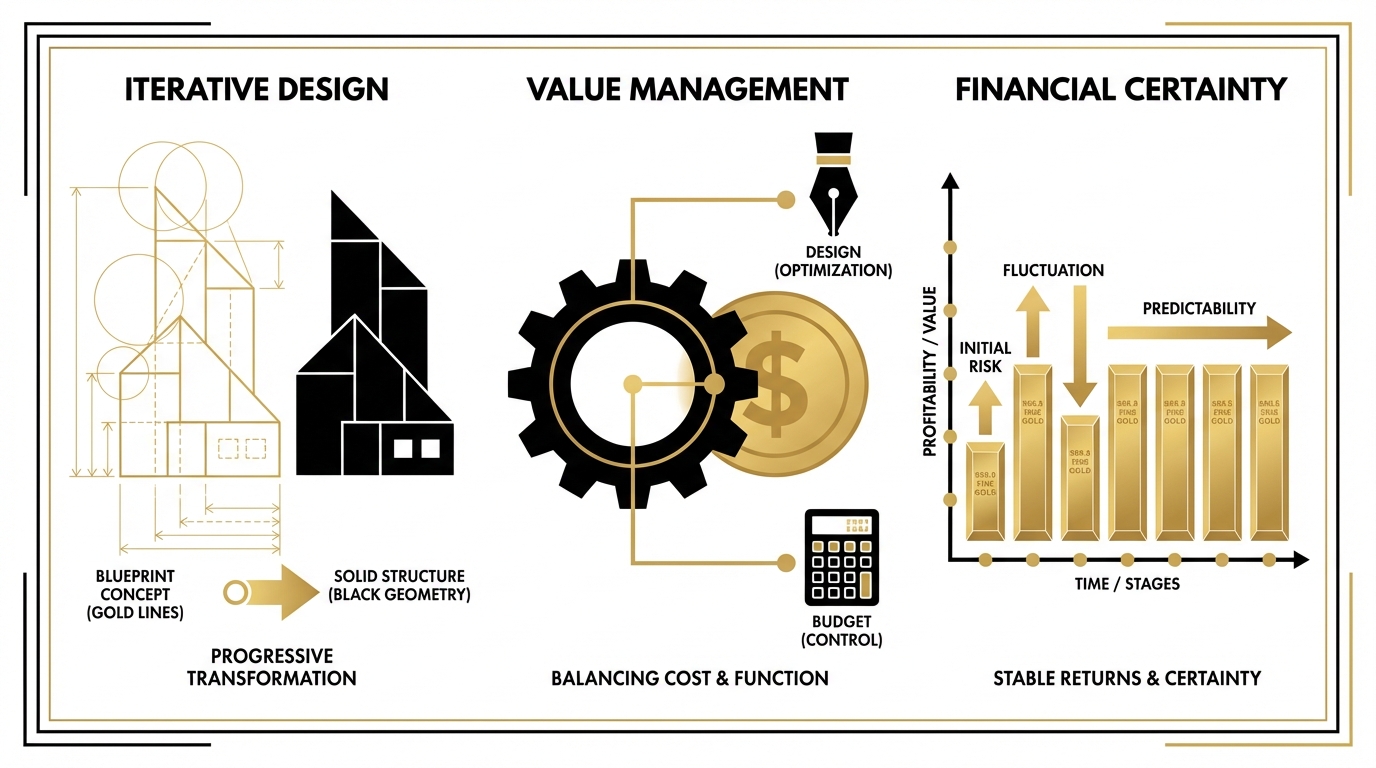
Our Approach: Financial Guardianship
We act as the custodians of your budget. Our role goes beyond counting bricks; we manage value through strategic intervention at every stage:
1
Cost Planning & Investment Appraisal
Quantity Surveyors act as the project's "financial conscience" from day one. Before design begins, we produce Preliminary Cost Estimates and feasibility studies to test the developer's business case (ROI).
The Process: This involves strict Cost Planning—allocating the budget to specific elements (e.g., Substructure vs. Finishes) to ensure the Architect designs within the client's financial reality, not just their aesthetic vision.
2
The "Bible" of the Site (Bills of Quantities)
The QS translates technical drawings into a commercial document: the Bills of Quantities (BQ). In Kenya, this is the primary instrument for competitive tendering. It ensures all contractors price the exact same scope of work, eliminating guesswork.
Risk Mitigation: A well-prepared BQ is the first line of defense against future disputes; if an item is in the BQ, it gets paid; if it’s missing, it becomes a contentious "claim."
3
Contractual & Procurement Strategy
Beyond counting bricks, the QS is the strategic advisor on how to buy construction services. We advise on the most appropriate form of contract—whether to use the domestic JBC "Green Book" for a Nairobi apartment block or the FIDIC suite for a complex civil engineering project.
Tender Management: We manage the tender process, evaluating bids not just on price, but on arithmetic errors and "front-loading" risks.
Tender Management: We manage the tender process, evaluating bids not just on price, but on arithmetic errors and "front-loading" risks.
4
Value Engineering & Life-Cycle Costing
Modern Quantity Surveying moves beyond "cost cutting" to Value Engineering (VE)—analyzing materials to maximize function while minimizing cost.
Example: Suggesting a different glazing spec that costs more upfront but saves millions in air conditioning bills over 10 years. This Life-Cycle Costing approach is critical for institutional investors who hold assets long-term.
5
Valuation & Final Account Settlement
During construction, the QS is the gatekeeper of cash flow. We visit the site monthly to measure work done and issue Interim Payment Valuations. This protects the client from overpaying (paying for work not done) and ensures the contractor has liquidity.
Closing the Book: At the project's end, we negotiate the Final Account, settling all variations and effectively "closing the book" on the project's financial liability.
Why Choose CCG as your QS?
We combine technical precision with commercial strategy to secure your investment.
Strategic Advisory
We guide you on the right contract forms (JBC vs FIDIC) to mitigate risk from day one.
Defensive Documentation
Our rigorous Bills of Quantities serve as a shield against ambiguous claims and disputes.
Cash Flow Gatekeepers
We ensure fair valuations that protect client capital while maintaining site momentum.
Ready to secure your project's financial future?
Don't let cost overruns derail your investment. Contact CCG today for a preliminary cost estimate and procurement strategy.
Request for a proposal