

It is a scenario that plays out in Kenyan boardrooms all too often: A contractor completes a complex infrastructure project—perhaps a new feeder road or a water treatment plant. The work is flawless, the quality is undeniable, and the project is handed over. But when the Final Account is presented, millions of shillings in legitimate claims for delays and variations are slashed to zero.
The reason? It wasn’t poor workmanship. It wasn’t a lack of evidence. It was a missing letter.
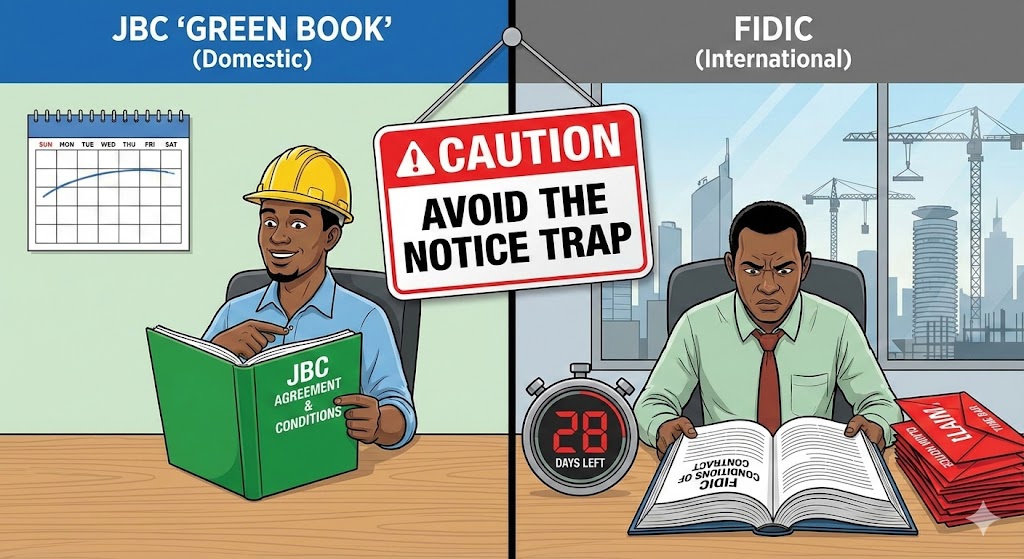
For Kenyan contractors accustomed to the domestic Joint Building Council (JBC) “Green Book,” moving to international projects governed by FIDIC contracts often results in a rude financial awakening. The primary culprit is a single, ruthless paragraph: Clause 20.1.
Here is why understanding the difference between these two contract forms is the most important profit-protection strategy you can adopt.
For decades, the JBC contract has been the “bread and butter” of the Kenyan building sector. Used primarily for private housing and office developments, it reflects a traditional, almost “gentlemanly” approach to construction.
Under the JBC (standard editions like 1999 or 2014), the Architect is the undisputed king. If a project is delayed or costs increase, the contractor is expected to inform the Architect. However, the timelines for doing so are often interpreted with leniency.
This flexibility has bred a culture where site progress takes precedence over contract administration. Unfortunately, this habit is dangerous when exported to civil engineering.
When you step into public infrastructure—roads, dams, energy—you enter the world of FIDIC (International Federation of Consulting Engineers). Unlike the JBC, FIDIC is not interested in “gentleman’s agreements.” It is a regime of strict compliance.
The most lethal weapon in the FIDIC arsenal is Clause 20.1 (Contractor’s Claims).
Clause 20.1 states that if the Contractor considers themselves entitled to an extension of time or additional payment, they must give notice to the Engineer within 28 days.
Crucially, the clock does not start ticking when you decide to write the claim. It starts ticking “after the Contractor became aware, or should have become aware, of the event or circumstance.”
This is where many Kenyan contractors lose money. In legal terms, this notice is a condition precedent to payment.
The “Notice Trap” catches contractors because it requires a fundamental shift in mindset:
In the JBC world, sending a formal claim letter is often seen as “adversarial” or aggressive. Contractors fear it will sour the relationship with the Architect or Client.
In the FIDIC world, the Notice of Claim is administrative, not aggressive. It is simply a data point. The Engineer needs to know immediately so they can advise the Employer on budget implications. By failing to notify, you deny the Employer the chance to mitigate the risk, which is why the penalty (forfeiture of claim) is so harsh.
If you are moving from JBC building works to FIDIC infrastructure projects, you must upgrade your contract administration immediately.
1. The “If In Doubt, Write It Out” Rule Do not wait to be sure how much a problem will cost. If you hit hard rock, send a notice. If the drawings are late, send a notice. You can always withdraw a claim later if it turns out to be minor. You cannot revive a dead claim after 28 days.
2. Automate Your Notices Create standard templates for “Notice of Claim.” Your site agents should be trained that sending these notices is as routine as pouring concrete. It shouldn’t require a board meeting to approve a letter.
3. Define “Day 1” Train your team to identify the “event.” In FIDIC, a conversation on site is not a notice. A mention in the Site Diary is not a notice. A formal letter or email to the Engineer is the only clock-stopper.
In the high-stakes environment of Kenyan infrastructure, the difference between profit and loss is rarely determined by the price of cement. It is determined by the discipline of your paperwork.
While the JBC “Green Book” offers a forgiving environment for the domestic builder, reliance on its leniency is a liability in the world of FIDIC. Master Clause 20.1, respect the 28-day rule, and ensure that you get paid for every shilling of value you deliver.
